EMT Practice Test

1. Question Content...


Question List

Question1: Consider the following statements:
1. Each contracted party is required to act responsibly to the organization and its stakeholders.
2. All decisions taken, processes used, and their implementation will not be allowed to create unfair advantage to any one particular party.
3. Digital Transformation and operations will be more effective and efficient.
4. Strategic decision-making by C-Level executives and business leaders will be more effective.
Which statements highlight the value and necessity for Architecture Governance to be adopted within organizations?

Question2: Which of the following statements about architecture partitioning is correct?

Question3: Please read this scenario prior to answering the question
You have been appointed as Chief Enterprise Architect (CEA). reporting to the Chief Technical Officer (CTO), of a company established as a separate operating entity by a major automotive manufacturer. The mission of the company is to build a new industry leading unified technology and software platform for electric vehicles.
The company uses the TOGAF Standard as the basis for its Enterprise Architecture (EA) framework, and architecture development follows the purpose-based EA Capability model as described in the TOGAF Series Guide: A Practitioners'Approach to Developing Enterprise Architecture Following the TOGAF ADM.
An end-to-end Target Architecture has been completed with a roadmap for change over a five-year period. The new platform will be a cross-functional effort between hardware and software teams, with significant changes over the old platform. It is expected to be developed in several stages over three years. The EA team has inherited the architecture for the previous generation hardware and software automotive platform, some of which can be carried over to the new unified platform. The EA team has started to define the new platform, including defining which parts of the architecture to carry forward.
Enough of the Business Architecture has been defined, so that work can commence on the Information Systems and Technology Architectures. Those need to be defined to support the core business services that the company plans to provide. The core services will feature an innovative approach with swarm data generated by vehicles, paving the way for autonomous driving in the future.
The presentation and access to different variations of data that the company plans to offer through its platform pose an architecture challenge. The application portfolio and supporting infrastructure need to interact with various existing cloud services and data- Refer to the scenario You have been asked what approach should be taken to determine and organize the work to deliver the requested architectures?
Based on the TOGAF standard which of the following is the best answer?

Question4: What is an objective of the ADM Preliminary Phase?

Question5: What are the four dimensions used to scope an architecture?

Question6: Which of the following best describes the purpose of the Architecture Roadmap?

Question7: Consider the following statements
1 A whole corporation or a division of a corporation
2 A government agency or a single government department
3 Partnerships and alliances of businesses working together such as a consortium or supply chain What are those examples of according to the TOGAF Standard?

Question8: Which one of the following classes of information within the Architecture Repository would typically contain a list of the applications in use within the enterprise?

Question9: Complete the sentence A set of architecture principles that cover every situation perceived meets the recommended criteria of_______________

Question10: Which of the following is the ability to develop use and sustain the architecture of a particular enterprise using architecture to govern change?

Question11: What is the purpose of the Preliminary Phase?

Question12: Which of the following best describes the purpose of the Gap Analysis technique?

Question13: Which of the following best describes the purpose of the Gap Analysis technique?

Question14: What is presented as "striking a balance between positive and negative outcomes resulting from the realization of either opportunities or threats?

Question15: Which section of the TOGAF template for Architecture Principles should highlight the requirements for carrying out the principle?

Question16: Complete the sentence The Enterprise Continuum provides methods for classifying architecture artifacts as they evolve from________________________.

Question17: Which of the following best describes a purpose of the Gap Analysis technique?

Question18: In which phase of the ADM cycle do building blocks become implementation-specific?
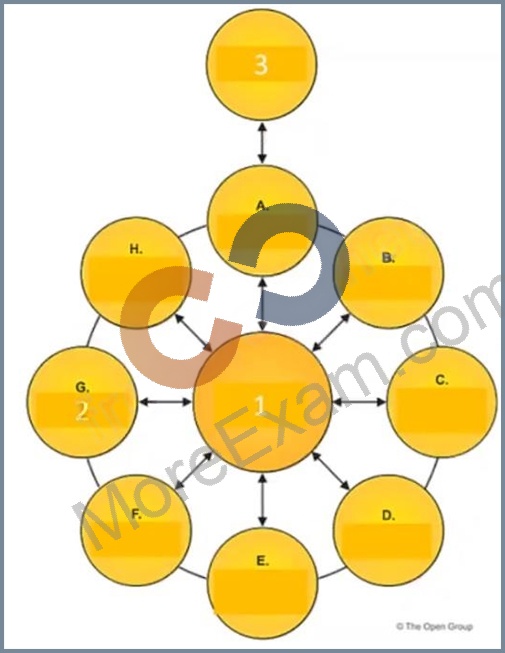
Question19: Exhibit

Consider the illustration showing an architecture development cycle Which description matches the phase of the ADM labeled as item 1?

Question20: Consider the following statement.
Projects may cycle between ADM phases, in planned cycles covering multiple phases.
What does it illustrate?

Question21: Consider the following ADM phases objectives.
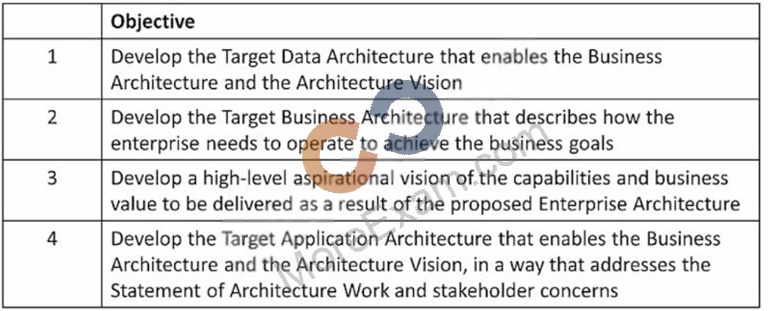
Which phase does each objective match?

Question22: Consider the following ADM phases objectives.
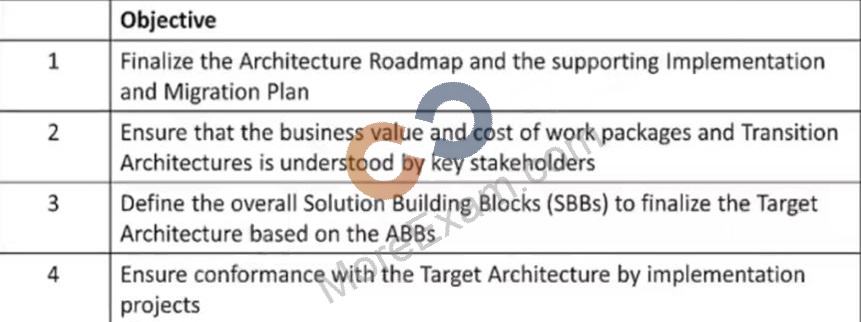
Which phase does each objective match?

Question23: Which of the following is included as part of Architecture Governance1?

Question24: Please read this scenario prior to answering the question
You are working as Chief Enterprise Architect at a large Internet company. The company has many divisions, ranging from cloud to logistics. The company has grown rapidly, expanding from initially selling physical books and media to a range of services including an online marketplace, live-streaming. eBooks. and cloud services.
Overall management of the numerous divisions has become challenging. Recent high-profile projects have overrun on budget and under delivered, damaging the company's reputation, and adversely impacting its share price. There is a widely held view within the executive management that the organization structure has played a major role in these project failures.
The company has an established Enterprise Architecture program based on the TOGAF standard, sponsored jointly by the Chief Executive Officer (CEO) and Chief Information Officer (CIO). The CEO has decided that the company needs to reorganize its divisions around artificial intelligence and machine learning with a focus on automation. The CEO has worked with the Enterprise Architects to create a strategic architecture for the reorganization, including an Architecture Vision, together with definitions for the four domain architectures. This sets out an ambitious vision of the future of the company over a three-year period. This includes a set of work packages and includes three distinct transformations.
The CIO has made it clear that prior to the approval of the detailed Implementation and Migration plan, the EAteam will need to assess the risks associated with the proposed architecture. He has received concerns from key stakeholders across the company that the proposed reorganization may be too ambitious and there is doubt whether it can produce sufficient value to warrant the risks.
Refer to the scenario
You have been asked to recommend an approach to satisfy these concerns. Based on the TOGAF Standard, which of the following is the best answer?

Question25: Exhibit

Consider the illustration showing an architecture development cycle Which description matches the phase of the ADM labeled as item 2?

Question26: The_________________ensures that a project transitioning into implementation also smoothly transitions into appropriate Architecture Governance.

Question27: Which section of the TOGAF template for Architecture Principles should describe the relationship to other principles?

Question28: Which statement about Requirements Management is most correct?

Question29: Consider the following descriptions of deliverables consumed and produced across the TOGAF ADM cycle.

Which deliverables match these descriptions?

Question30: Which of the following describes how the Enterprise Continuum is used when developing an enterprise architecture?

Question31: Which of the following is a responsibility of an Architecture Board?

Question32: In which part of the ADM cycle do building block gaps become associated with work packages that will address the gaps?

Question33: What are the following activities part or?
* Initial risk assessment
* Risk mitigation and residual risk assessment
* Risk monitoring

Question34: Please read this scenario prior to answering the question
Your role is consultant to the Lead Architect within a multinational company that manufactures electronic components. The company has several manufacturing divisions located worldwide and a complex supply chain. After a recent study, senior management have stated a concern about business efficiency considering the company's multiple data centers and duplication of applications.
The company has a mature Enterprise Architecture (EA) practice and uses the TOGAF architecture development method in its EA practice. In addition to the EA program, the company has several management frameworks in use, including business planning, project/portfolio management, and operations management. The EA program is sponsored by the CIO.
A strategic architecture has been defined to improve the ability to meet customer demand and improve management of the supply chain. The strategic architecture includes the consolidation of multiple Enterprise Resource Planning (ERP) applications that have been operating independently in the divisions' production facilities.
Each division has completed the Architecture Definition documentation to meet its own specific manufacturing requirements. The enterprise architects have defined a set of work packages that address the gaps identified. They have identified the value produced, effort required, and dependencies between work packages to reach a farget architecture that would integrate a new ERP environment into the company.
Because of the risks posed by change from the current environment, the architects have recommended that a phased approach occurs to implement the target architecture with several transition states. The overall implementation process is estimated to take several years.
Refer to the scenario
You have been asked what the next steps are for the migration planning.
Based on the TOGAF standard which of the following is the best answer?

Question35: Please read this scenario prior to answering the question
Your role is that of a consultant to the Lead Enterprise Architect to an international supplier of engineering services and automated manufacturing systems. It has three manufacturing plants where it assembles both standard and customized products for industrial production automation. Each of these plants has been operating its own planning and production scheduling systems, as well as applications and control systems that drive the automated production line.
The Enterprise Architecture department has been operating for several years and has mature, well-developed architecture governance and development processes that are based on the TOGAF Standard. The CIO sponsors the Enterprise Architecture.
During a recent management meeting, a senior Vice-President highlighted an interview where a competitor company's CIO is reported as saying that their production efficiency had been improved by replacing multiple planning and scheduling systems with a common Enterprise Resource Planning (ERP) system located in a central data center. Some discussion followed, with the CIO responding that the situations are not comparable, and the current architecture is already optimized.
In response, the Architecture Board approved a Request for Architecture Work covering the investigations to determine if such an architecture transformation would lead to improvements in efficiency. You have been assigned to support the architecture team working on this project.
A well-known concern of the plant managers is about the security and reliability of driving their planning and production scheduling from a remote centralized system. Any chosen system would also need to support the current supply chain network consisting of local partners at each of the plants.
Refer to the scenario
You have been asked to explain how you will initiate the architecture project.
Based on the TOGAF Standard, which of the following is the best answer?

Question36: Refer to the table below:

Which ADM Phase does this describe?

Question37: Which of the following describes a purpose of Architecture Principles?

Question38: Consider the following ADM phases objectives.
Objective
1- Determine whether an incremental approach is required, and if so identify Transition Architectures that will deliver continuous business value
2- Generate the initial complete version of the Architecture Roadmap, based upon the gap analysis and candidate Architecture Roadmap components from Phases B, C, and D
3- Finalize the Architecture Roadmap and the supporting Implementation and Migration Plan
4- Ensure that the business value and cost of work packages and Transition Architectures is understood by key stakeholders Which phase does each objective match?

Question39: Consider the following statement:
According to the TOGAF Standard a governed approach of a particular deliverable will ensure a system of continuous monitoring to check integrity changes decision-making and audit of all architecture-related activities Which deliverable is being referred to?

Question40: What component of the Architecture Repository represents architecture requirements agreed with the Architecture Board?